


Ready to make an impact on your employees, customers, and recipients? Click the button to register your organization. Keep your business EIN handy.
Control Healthcare Costs by Increasing Preventive Care Completion
Many employees don’t complete the preventive care actions that reduce long-term costs.
Fix the incentive structure—and only pay when those actions are completed.

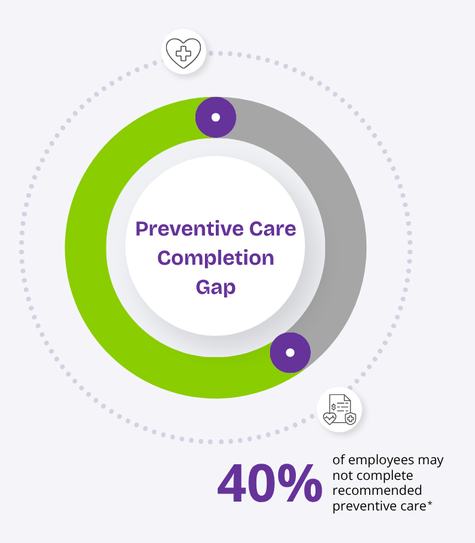
Employee Inaction Raises Healthcare Costs.
You already invest in preventive care—annual visits, screenings, biometrics, and adherence programs.
But many employees don’t complete them.
High-cost conditions go undetected or unmanaged and expected cost savings never materialize.
When employees don’t take action, you carry the financial risk—because as the plan sponsor, you are the risk bearer.
The problem isn’t access. It’s getting employees to actually complete the actions.
%20(250%20x%20250%20px)%20(1).png)
Why most incentive strategies don’t drive behavior
Most employer incentive programs are built around distribution, not outcomes.
1. Rewards are generic and not tied to health actions2. Incentives are delayed or disconnected from behavior
3. Premium differentials feel like penalties, not motivation
4. There’s no clear link between action → reward → cost impact
The result is low completion, wasted incentive spend, and no clear ROI story for leadership.
If you improve completion, you improve outcomes and reduce cost risk
Preventive care only works if employees complete it. When preventive actions go incomplete, small, manageable issues escalate into high-cost conditions.
Instead of adding more programs, fix the missing piece: how incentives are structured.
When incentives are clearly tied to specific, verified actions and delivered in a way that feels immediate and meaningful, they shift from passive perks to active drivers of behavior.
The result is a more predictable, controllable path from preventive care investment to actual cost savings
Incentives that drive measurable completion

Incentives tied to verified actions—not participation
We help you drive completion by restructuring incentives around verified employee actions, like:
- Annual wellness visits
- Preventive screenings
- Biometric testing
- Medication adherence
How it works:
- Incentives are triggered only after completion
- Rewards are tied directly to the behavior you want
- Every dollar spent connects to a measurable outcome
This creates a clear path: Action → Completion → Reward → Measurable Impact
See how incentives drive completion
Only pay for outcomes—not intent
Traditional incentive programs create waste:
- Prefunded budgets go unused
- Rewards are issued without behavior change
- ROI is unclear
Our model changes that:
- Fund-on-claim: Pay only when actions are completed
- Reduced waste: No unused incentive budgets
- Better allocation: Spend tied directly to cost-reducing behaviors
Every incentive dollar is accountable.
Let's discuss a better approach
Incentives that reinforce healthy behavior
Incentives work best when they reinforce the action they’re tied to.
With health-focused gift card incentives:
- Employees complete a screening or visit
- Receive a reward
- Use it for real health-related needs
This creates a reinforcement loop:
Complete care → Get rewarded → Reinforce behavior
And ensures your incentive spend supports the outcomes you’re trying to drive
Explore incentive options
You don’t just need engagement—you need results you can defend.
With the right structure, you can track:
- Completion rates by program
- Cost per completed action
- Changes in preventive care utilization
- Impact on overall health spend
This turns incentives into a measurable cost-control strategy—not a perk.
Use cases that drive measurable completion
Focus incentives on high-impact actions where completion directly improves outcomes and reduces cost risk.

Preventive Screenings

Annual Wellness Visits
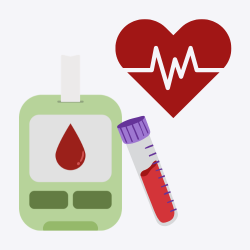
Biometric Screenings & Bloodwork
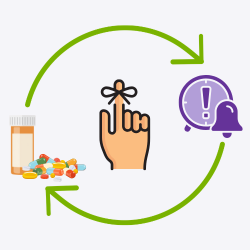
Medication Adherence Programs

HRA Completion
Start small. Prove what works.
You don’t need to overhaul your entire program. Start with:
One employee population
One preventive action
One measurable outcome
Measure completion lift, cost per completed action, and program impact within 60–90 days.
No upfront complexity. No wasted spend. Just measurable results.
Run a pilot program today!
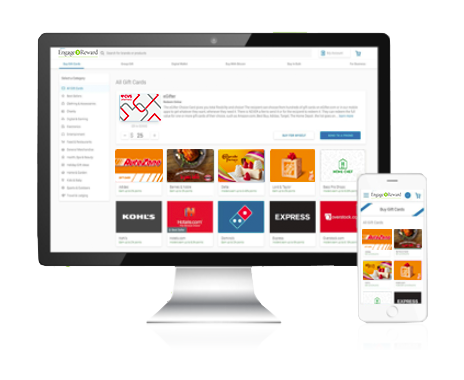
The Engage2Reward Platform: Built for Control and Accountability
We don’t just distribute incentives. We help you structure them for measurable performance:
- Tie incentives to verified employee actions
- Only pay for completed behaviors
- Configure by population or program
- Deploy without increasing admin burden
- Report on outcomes—not just activity
This is about control, accountability, and measurable outcomes—at scale.
Register Your Business For Free