



Employers are navigating a difficult balancing act: controlling labor costs while maintaining employee engagement, retention, and productivity. While inflation has cooled from peak levels, the cost of everyday essentials—especially food, transportation, and housing—continues to shape how employees experience financial stress.
According to the U.S. Bureau of Labor Statistics Consumer Expenditure Survey, the average U.S. household spent $78,535 per year in 2024, with housing and transportation alone accounting for over 50% of total household spending, making them the largest financial burdens for most workers. Additionally, households spent an average of $6,224 on food at home in 2024, reinforcing how essential expenses dominate household budgets.
At the same time, workplace engagement and wellbeing indicators are trending in the wrong direction. Gallup reports that U.S. employee engagement fell to 31% in 2024, a 10-year low, and employee wellbeing has declined, with fewer workers reporting they are “thriving.”
These trends are connected. When financial pressure rises, engagement, attendance, and retention often decline. For employers, this creates a strategic question: How do you support employees and reinforce performance without increasing fixed compensation costs?
This is where incentives for everyday needs come into play.
Short on time? Listen to the podcast episode on-the-go.
Why Everyday-Needs Incentives Feel More Valuable to Employees
Traditional rewards like merchandise can be appreciated, but they don’t always address what employees need most right now: help with recurring, essential expenses.
Financial pressure is not just about income—it’s about cash flow. When employees are worried about groceries, fuel, or commuting costs, practical rewards often feel more meaningful than discretionary ones.
Gallup research shows that employee wellbeing is closely tied to productivity and retention outcomes, and employees who are thriving are less likely to miss work and less likely to look for another job. This reinforces an important idea: supporting employees’ real-world financial pressures can indirectly support workforce stability and performance.
That’s why incentives tied to everyday needs—such as pharmacy, grocery, gas, and EV charging reward cards—often deliver higher perceived value. They don’t feel like a perk; they feel useful. Practical rewards and incentives help promote medication adherence, reliable transportation, and healthy eating.
How Reward Cards Can Reinforce Behavior, Not Replace Compensation
It’s important to clarify something: incentives alone do not solve financial stress, and they are not a replacement for wages or bonuses.
What they can do is reinforce specific behaviors that organizations need to drive, such as:
- Attendance and reliability
- Safety milestones
- Performance goals
- Training completion
- Retention milestones
- Participation in company initiatives
When incentives are tied to measurable behaviors and delivered consistently, they act as reinforcement tools. When those incentives help cover everyday expenses, they also carry immediate, practical value for employees.
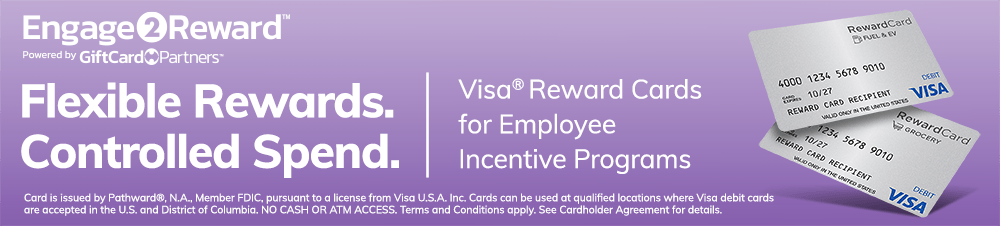
This is where category-restricted Visa® Reward Cards become especially effective. Cards restricted to grocery, fuel, or EV charging categories provide flexibility while ensuring the incentive is used for its intended purpose. This creates a balance between employee choice and employer program control.
The Employer Perspective: Control, Visibility, and Cost Efficiency
From an employer perspective, incentives must be more than appreciated — they must be defensible, trackable, and aligned with business goals.
Well-structured everyday-needs incentive programs allow organizations to:
- Tie rewards to measurable outcomes
- Control where incentive funds are spent
- Track distribution and usage
- Manage budgets by department, location, or program
- Scale incentives across distributed or frontline workforces
- Maintain cost control without increasing fixed compensation
This is why infrastructure matters as much as the reward itself.
Platforms like the Engage2Reward™ Gift Card Ordering Platform allow organizations to distribute digital or physical Visa Reward Cards, including category-restricted grocery, fuel, and EV charging cards, while maintaining program governance through:
- Bulk and triggered delivery
- Campaign tracking
- Reporting dashboards
- Secure fulfillment
- API integrations with HRIS or payroll systems
- Category-restricted prepaid options for spend control
In other words, the reward is the reinforcement tool, but the platform is what makes the program scalable and measurable.
What’s in It for the Employer vs. the Employee?
A successful incentive program works because it creates value for both sides.
For Employers:
- Reinforces attendance, performance, and safety behaviors
- Supports retention in high-turnover roles
- Provides meaningful rewards without increasing base pay
- Maintains budget control and reporting visibility
- Aligns incentive spend with measurable outcomes
For Employees:
- Helps offset everyday expenses like groceries and fuel
- Easy to use in locations they already shop
- Flexible but still practical
- Delivered digitally or physically for convenience
- Feels relevant to real-life financial needs
When incentives align with what employees actually spend money on every week, they are more likely to be perceived as meaningful — and meaningful incentives are more likely to drive behavior.
The Strategic Takeaway
Employers do not need to choose between cost control and employee support. The most effective workforce incentive strategies in today’s environment do both.
Incentives for everyday needs—especially pharmacy, grocery, fuel, and transportation reward cards—represent a shift in how organizations think about rewards. Instead of discretionary perks, they become practical reinforcement tools that support employee stability while driving measurable workplace behaviors.
The organizations seeing the most success are not simply giving rewards. They are designing incentive programs tied to outcomes, controlling spend categories, and tracking results.
That’s the difference between rewards as a cost and incentives as a strategy.
Schedule a call with our team today to design an everyday-needs incentive program that supports your workforce while maintaining cost control and program visibility.




.png?width=600&height=600&name=3D8DC522-2245-490E-AA26-63567A199A4C%20.png)