



Small rewards for employees are rewriting the rules of modern engagement. Across hospitality, retail, gig platforms, and fast-moving operations, performance doesn’t happen once a quarter; it happens every shift, every interaction, and every task. That’s why micro-rewards are emerging as a strategic advantage, giving teams motivation exactly when they need it and leaders a scalable way to reinforce behaviors that drive results. If you’re exploring what micro-rewards are and why they matter, this guide breaks down the psychology, the data, and the practical ways to bring them to life.
Why Frequent Rewards Win: A Behavioral-Science Perspective
Data shows that 3 in 4 workers would be more productive if they received recognition more often (5). Frequent recognition delivers a psychological “feedback loop” that helps employees connect their daily effort with a visible reward. This isn’t just feel-good thinking; it reflects evidence-based motivation.
- Immediate reinforcement matters. When employees receive a small reward after a task or shift, their brain links the behavior with a positive outcome. IRF research found that smaller, frequent rewards improved quality and output more than lump-sum rewards (2).
- Small rewards create sustained motivation. Large and infrequent bonuses often trigger only a brief dopamine spike, while a short dopamine spike, but micro-rewards keep that motivational energy flowing throughout the month.
- Gift cards avoid rewarding fatigue. Because gift cards act like quasi-cash with variety, especially when delivered in different brands and denominations, they avoid the saturation effect seen with repetitive merchandise (2).
For industries where performance must stay consistent day after day, micro-rewards offer a practical, cost-effective way to keep motivation high without waiting for annual cycles.
If you enjoy exploring employee-motivation strategies, don’t miss our related insights in Top 5 Ideas to Increase Employee Engagement Through Gift Cards and Addressing Employee Detachment: Strategies to Reconnect & Reengage Your Workforce.
How Gift Cards Make Micro-Rewards Easy
A reward strategy thrives when it remains simple to manage. That’s where the Engage2Reward™ Gift Card Ordering Platform removes friction and gives leaders the freedom to scale recognition with zero complexity.
- Streamlined Gift Card Buying Process: Whether you prefer digital rewards for instant gratification, personalized touches, or the timeless appeal of physical gift cards, the platform delivers a smooth and intuitive purchase flow.
- Customizable Orders: Select the reward type, choose denominations starting at $5, enter quantities, and tailor each order to your exact program needs.
- Real-Time Delivery: Send digital or physical cards instantly for same-day reinforcement, ideal for performance-based micro-rewards.
- Flexible Payment Options: Choose from ACH, wire, check, or deposit account setup for maximum operational ease.
With fast delivery and full customization, the Engage2Reward Platform makes it simple to maintain small, frequent recognition without adding administrative weight.

A World of Reward Options Employees Truly Want
Micro-rewards succeed only when employees genuinely value what they receive. The combination of flexibility, brand variety, and prepaid reward cards gives recipients the freedom to choose what matters most.
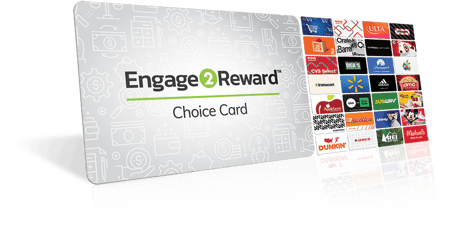
- Engage2Reward™ Choice Card: Offer unmatched flexibility with a single reward that unlocks hundreds of gift card brands. Customizable with company branding and personalized greetings, the Engage2Reward Choice Card is ideal for upholding company culture for diverse teams and varied preferences.
- Prepaid Reward Cards: Recipients can shop with globally accepted payment networks for everyday spending, meals, travel, or entertainment, making them exceptionally versatile.
- Barnes & Noble and Office Depot® OfficeMax®: Popular options that support learning, productivity, and practical needs, making them powerful tools in small rewards for employees programs.
- CVS® gift cards: Flexible, convenient support for wellness and everyday items, redeemable at over 7,000 locations nationwide.
A micro-reward strategy works best when employees feel seen. These options make that possible without increasing budgets.
If you’re exploring broader workforce trends shaping recognition strategy, check out State of the Workplace Going into 2026: Employee Trends You Need to Know.
 The Proof: Why Small, Frequent Rewards Outperform Big Bonuses
Micro-rewards consistently deliver measurable impact, and the numbers overwhelmingly support it.
- Budgets are growing: 59% of North American companies plan to increase recognition budgets in 2025 (1).
- Moderate spending is the norm: 62% of reward programs budget $100–$500 per employee annually, proving that micro-rewards are not only psychologically effective but financially realistic (1).
- Gift-card values are shrinking, by design: Average gift-card denominations dropped to $142 in 2024, and $50 and $100 cards now make up 51% of distributions. Many companies issue $25 cards for spot rewards, making micro-rewards the new standard (1).
- Employees overwhelmingly prefer gift cards: Eighty percent prefer gift cards as rewards, 86% say they make great workplace gifts, and 77% love having the freedom to choose what they buy (3).
- Recognition frequency drives engagement: Eighty-two percent of employees recognized monthly feel enthusiastic, and 45% recognized monthly are highly engaged (4).
- Retention improves dramatically: Companies with effective recognition programs see 31% less voluntary turnover, while employees without recognition are twice as likely to consider leaving (4).
- Reward frequency matters: IRF’s academic review found that smaller, more frequent rewards produced higher output and quality than lump sums, especially when using cash-like or fungible rewards. Gift cards avoid habituation by offering choice and variety (2).
Whether your goal is productivity, retention, engagement, or daily quality, micro-rewards consistently outperform large bonuses, and the data is conclusive.
Final Thoughts
Micro-rewards have evolved from a trend into a strategic necessity. They meet employees where they are, reward effort as it happens, and align with modern budgets. Whether you run a busy restaurant, coordinate gig-economy workers, manage retail teams, or lead professional staff, small rewards for employees unlock better performance without waiting for year-end reviews. With flexible tools like the Engage2Reward Platform, there has never been a more practical moment to build a recognition program that motivates continuously, not occasionally.
References
- Industry Outlook for 2025: Merchandise, Gift Cards, and Event Gifting. IRF, 2024, https://theirf.org/research_post/industry-outlook-for-2025-merchandise-gift-cards-and-event-gifting/.
- Academic Research in Action: The Effect of Reward Frequency on Performance. IRF, 2024, https://theirf.org/research_post/academic-research-in-action-the-effect-of-reward-frequency-on-performance/.
- “When It Comes to Workplace Incentives, Employees Prefer Gift Cards.” Digital Transactions, 2024, https://www.digitaltransactions.net/when-it-comes-to-workplace-incentives-employees-prefer-gift-cards/.
- “Employee Recognition Statistics.” Achievers, 2025, https://www.achievers.com/blog/employee-recognition-statistics/.
- “26 Employee Recognition Statistics You Need To Know In 2025.” Nectar, 2025, https://nectarhr.com/blog/employee-recognition-statistics



.png?width=600&height=600&name=3D8DC522-2245-490E-AA26-63567A199A4C%20.png)