



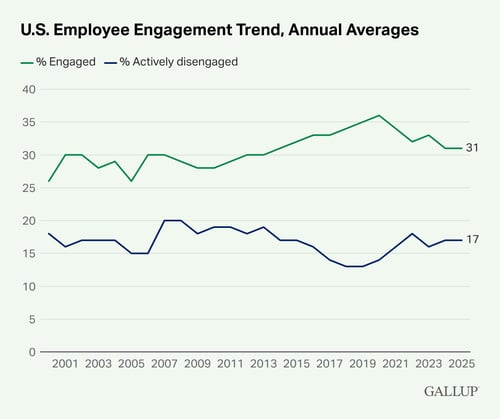
Employee engagement in the U.S. has stalled at 31%, down from its pandemic-era peak and representing millions fewer engaged workers across the workforce. New findings from Gallup reveal a deeper issue behind the headline numbers: engagement isn’t eroding because employees don’t care; it’s declining because basic workplace needs are going unmet, especially for younger workers.
For organizations planning their 2026 engagement strategies, the takeaway is clear: restoring engagement starts with clarity, communication, and visible follow-through.
Younger Workers Are Feeling the Impact First
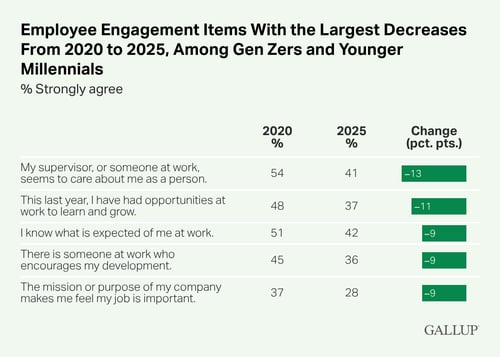
The steepest engagement declines are among Generation Z and younger millennials, who report significantly lower levels of:
-
Feeling cared about as a person
-
Having opportunities to learn and grow
-
Understanding what success looks like in their role
These workers are earlier in their careers and more dependent on clear expectations, consistent feedback, and development signals. When those fundamentals weaken, engagement drops quickly — and so does retention.
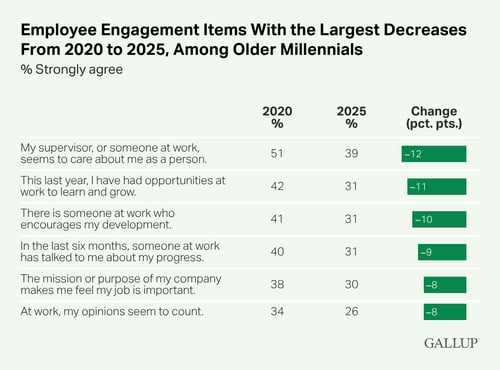
Older millennials show similar patterns, reinforcing that this isn’t a generational preference issue. It’s a systems issue.
Engagement Is Breaking Down at the Basics
Gallup’s qualitative findings point to two core breakdowns:
1. Unclear Expectations
Employees overwhelmingly say they need:
-
Better communication from managers
-
Greater transparency around company direction
-
Clear definitions of what “exceptional performance” looks like
Less than one-third of leaders strongly agree they have a clear definition of excellence, and clarity is even lower for managers and individual contributors. Yet employees who do have this clarity are nearly four times more likely to be engaged.
2. Feeling Cared About — Not Just Compensated
While pay and benefits matter, most employees say feeling cared about comes from:
-
Respectful, two-way communication
-
Being listened to when concerns are raised
-
Supportive relationships with managers
Engagement suffers when organizations substitute platitudes for action or recognition without substance.
Why Recognition and Rewards Still Matter — When Used Correctly
Recognition alone won’t fix engagement. But misaligned or inconsistent recognition can actively undermine it.
When expectations are unclear, rewards feel arbitrary. When communication is weak, recognition feels transactional. And when development stalls, incentives lose meaning.
This is where modern reward infrastructure plays a supporting role.
Turning Engagement Strategy Into Consistent Action
Solutions like the Engage2Reward™ Gift Card Ordering Platform help organizations operationalize engagement, not replace leadership or culture. When used intentionally, rewards can:
-
Reinforce clearly defined performance behaviors
-
Acknowledge progress, not just outcomes
-
Support development milestones and participation
-
Scale recognition without losing personalization
With features like digital and physical delivery options, campaign management, choice-based rewards, and reporting visibility, the Engage2Reward Platform enables organizations to connect recognition to clarity, ensuring rewards are timely, consistent, and aligned with expectations.

The 2026 Opportunity: Restore Clarity First
Gallup’s data doesn’t point to a workforce that’s disengaged by choice. It points to one navigating ambiguity, change, and stalled development.
In 2026, organizations that regain momentum will be those that:
-
Clarify what success looks like
-
Communicate direction consistently
-
Invest in growth signals employees can feel
-
Use rewards to reinforce — not replace — strong management
Engagement doesn’t improve through perks alone. It improves when employees understand where they’re going, how they’re doing, and why their work matters — and when recognition shows up to support that journey.
Ready to inject your employee engagement strategy with powerful incentives and rewards? Contact our team today to get started.




.png?width=600&height=600&name=3D8DC522-2245-490E-AA26-63567A199A4C%20.png)