



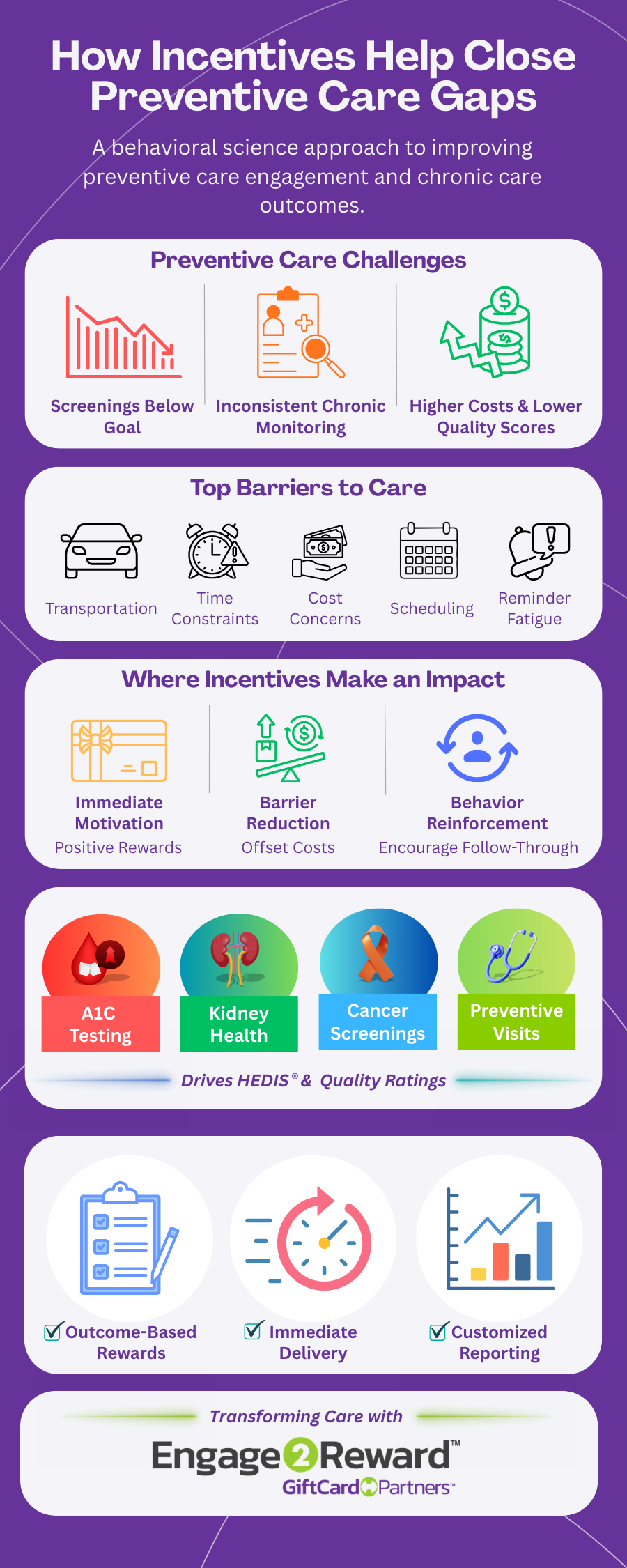
Preventive care and chronic condition monitoring are essential pillars of high-quality health care, particularly within modern Value-Based Care (VBC) and population health management models. Yet many care gaps persist. Even as plans rebound from pandemic-era disruptions, real-world evidence from the CDC shows incomplete preventive care remains a systemic challenge with measurable implications for HEDIS® measure performance, Star Ratings improvement, and total cost of care reduction.
Behavioral science suggests that small, timely incentives are among the most effective tools to help close these gaps — not by “buying health,” but by aligning member activation and incentivized health behaviors with care pathways that lead to better outcomes, reduced costs, and improved quality performance.
Within proactive care models, incentives serve as a powerful mechanism for preventive health engagement, helping plans move members from passive outreach to measurable action.
Tools like the Engage2Reward™ Gift Card Ordering Platform, which have long supported managed care organizations in building scalable incentive programs, make it possible to operationalize these strategies while maintaining CMS compliance alignment and secure PHI-compliant infrastructure.
Short on time? Listen to the podcast episode on-the-go.
Care Gap Reality: What the Latest Data Shows
Preventive and Chronic Care Utilization Still Under Pressure
Despite recovery in some areas of care utilization after the COVID-19 pandemic, data from a national EHR-based study (30+ million U.S. adults) shows the use of several preventive services — including mammograms and colonoscopies — remain below expected pre-pandemic levels.
For organizations focused on risk stratification, high-risk member identification, and early intervention, this gap highlights a key operational issue: simply reminding members to act is no longer enough.
Closing these gaps requires stronger preventive outreach campaigns, omnichannel outreach, and incentive-driven activation strategies that support care navigation and remove real-world barriers to participation.
2024 Quality Measure Trends
Newly reported quality measure data from 2024 reveals modest gains in priority outcomes across commercial health plans:
- Hemoglobin A1C control improved by ~6–10 percentage points in some populations.
- Colorectal cancer screening rates rose nearly 5 percentage points.
- Breast cancer screening showed measurable gains in reported performance.
These improvements signal traction, but they also reveal large remaining opportunities.
For plans operating within risk-based contracting environments, even incremental adoption can meaningfully influence quality metrics optimization, risk adjustment optimization, and medical cost avoidance.
Preventive engagement strategies that incorporate incentives are increasingly being layered into broader population health management initiatives and health equity initiatives, particularly for populations facing Social Determinants of Health (SDoH) barriers.
Statistical Reality Behind Office Visits
National HEDIS quality standards and NCQA health plan ratings continue to anchor how these measures are defined and scored, and they remain among the most influential metrics in health plan quality frameworks.
Improving these measures requires a shift from episodic care toward longitudinal care management and proactive member activation supported by data-backed outreach and predictive outreach modeling.
How Rewards Influence Member Behavior
Financial incentives — including digital gift cards or vouchers tied to preventive care completion — are supported by strong evidence as an effective strategy, particularly among vulnerable or low-income populations, to increase preventive care uptake.
Public health research consistently ranks financial incentives top among strategies that enhance preventive care utilization, citing substantial increases in uptake when patients are motivated with tangible rewards.
Within modern patient engagement platforms, incentives act as behavioral reinforcements that convert outreach into action. Organizations using incentive infrastructure such as the Engage2Reward Platform and Engage2Reward™ Gift Card API are able to embed these rewards directly into care coordination workflows, care navigation programs, and automated member touchpoints, strengthening participation across preventive initiatives.
Core Mechanisms Where Incentives Work
- Reduce real-world barriers tied to Social Determinants of Health, such as transportation or time costs
- Create clear action prompts reinforced through closed-loop communication and immediate reward delivery
- Boost follow-through on recommended clinical actions through personalized care journeys
.png?width=900&height=225&name=professional-development-banner-ad%20(4).png)
High-Impact Care Gap Targets With New Incentive Strategies
Here’s how incentives can specifically accelerate performance across key chronic and preventive measures where data shows continued gaps.
1. A1C Testing & Diabetes Monitoring
A1C control remains a marker of population health performance. Although some improvement is being seen in national data, most plans still report under-target compliance rates.
Within Chronic Care Management (CCM) and disease state management programs, incentivizing A1C testing and follow-up can help drive more frequent care adherence and support better long-term glucose outcomes.
Programs that integrate incentives with care coordination and predictive analytics can proactively engage diabetic populations who are overdue for testing.
2. CKD Labs & Monitoring
Kidney disease often goes underrecognized without routine lab surveillance. Guidelines now emphasize CKD monitoring within chronic disease management, and plans report evolving measure updates that reflect kidney health assessments in 2024.
Rewards linked to verified lab completion can overcome inertia and move early disease detection upstream. This approach supports early intervention strategies, which are critical for slowing disease progression and reducing long-term healthcare costs.
3. Cancer Screenings
Cancer screening performance remains a consistent priority within population health initiatives and value-based care contracts. National cancer screening guidelines position early detection as critical to improved survival — yet adoption varies widely.
Programs that drive member participation, especially for colorectal and breast cancer screenings (where recent data shows under-utilization), can generate measurable quality gains that benefit populations directly and plans indirectly.
4. Cardiovascular & Preventive Health Check-Ins
Cardiovascular care — including blood pressure control, Annual Wellness Visits (AWV), and preventive check-ins — remains a cornerstone of chronic disease management. Recent measure data shows sustained improvement in controlling high blood pressure when proactive outreach, telehealth enablement, and automated member touchpoints are used.
Adding incentives to routine preventive visits or biometric checks can increase participation rates across preventive programs and strengthen whole-person care models.
Designing Incentives for Real Quality Gains
To be effective in modern care models, incentive programs should be:
1. Outcome-Focused
Reward structures must require verified completion of the clinical action (lab, screening, visit) before reward issuance. This ensures incentives align with outcomes-based care frameworks, HEDIS measures, and CMS compliance requirements while protecting program integrity.
2. Delivered Immediately
Timing matters. Rewards delivered promptly after completion significantly strengthen behavioral reinforcement. Immediate delivery also supports incentive-driven activation models, which improve participation across preventive engagement initiatives.
3. Integrated With Care Workflows
Incentives work best when integrated with EHR systems, patient engagement platforms, and care management tools. Through API-driven integration and data interoperability, incentive programs can automatically trigger rewards once claims or clinical data verify completion.
This reduces administrative burden while ensuring program accuracy.
 Click image to expand
Driving Measurable Quality and Member Experience
With recent quality measure reports showing incremental gains yet persistent gaps, rolling out incentive-based interventions isn’t just innovative — it’s strategic.
Plans that incorporate structured rewards into population health management and preventive care optimization strategies can expect:
- Higher screening completion rates
- Better performance on public quality measures such as HEDIS® and NCQA Health Plan Ratings
- Stronger ROI on preventive engagement and measurable medical cost avoidance
Behavioral science and real-world evidence increasingly validate what forward-thinking plans are proving operationally: member behavior responds to incentives, especially when barriers are tangible and timely reinforcement is provided.
Incentives as Strategic Quality Tools, Not Giveaways
Delivering better health outcomes requires more than reminders. It requires motivating members where they are — and doing so with data-driven precision and rapid fulfillment.
When structured with outcome rigor, aligned to evidence-based quality measures, and implemented alongside clinical workflows, incentives transform passive reminders into active care completion.
Closing care gaps is not merely an aspiration. It is a population health operational priority that incentive-driven engagement can help solve at scale.
Powering Preventive Incentives with Reward Platforms
Turning incentive strategy into measurable quality improvement requires more than gift cards. It requires infrastructure.
The Engage2Reward Platform enables healthcare organizations to deploy secure, scalable, CMS-aligned incentive programs that support preventive engagement without adding operational strain to care teams.
For years, the Engage2Reward Platform has supported managed care organizations and population health programs in delivering reward strategies that meet member expectations while maintaining strict program compliance.
Why the Engage2Reward Platform Works for Care Gap Closure
Outcome-Based Control: Rewards can be issued only after verified completion of a screening, lab, or visit. This supports closed-loop communication and outcome verification, aligning programs with HEDIS and CMS guidelines.
Digital & Physical Flexibility: Deliver incentives instantly via email or SMS for immediate reinforcement, or distribute physical cards when populations require offline access.
Health-Aligned Reward Options: Choose from pharmacy, grocery, transportation, and general-use cards that help members overcome SDoH-related barriers tied to preventive care.
Bulk & Direct-to-Member Fulfillment: Launch large-scale campaigns across high-risk populations or target specific segments such as diabetic members overdue for A1C testing or individuals missing cancer screenings.
Secure, Auditable Infrastructure: Enterprise-level security and reporting capabilities provide the documentation needed for compliance, finance, and utilization management teams.
Real-Time Reporting & Budget Controls: Track participation rates, reward distribution, and campaign performance in a centralized dashboard to evaluate cost per closed gap, ROI, and quality revenue impact.
From Strategy to Measurable Action
Preventive incentive programs succeed when they are:
- Easy for members to understand
- Simple for care teams to administer
- Secure for compliance leaders
- Transparent for executives
The Engage2Reward Platform bridges the gap between behavioral science and operational execution, helping health plans and care organizations convert outreach into verified action.
If closing care gaps is the goal, the right platform makes it scalable.




.png?width=600&height=600&name=3D8DC522-2245-490E-AA26-63567A199A4C%20.png)