



Successful holiday incentive programs depend more on operational planning than on choosing the perfect year-end reward. Most organizations don't set out to run a poor incentive program. They budget thoughtfully, choose meaningful rewards, and genuinely want to recognize employees, customers, and partners with bonuses and rewards at year-end.
Yet many programs still fall short. Rewards arrive late, budgets creep upward, and global recipients receive options they can't use. Approvals stall distribution and reporting is incomplete, making it difficult to evaluate success or improve next year's program.
These issues rarely stem from choosing the wrong reward. More often, they're the result of operational complexity that wasn't planned for. Holiday incentive programs require scalable planning, governance, fulfillment, and reporting.
As holiday and year-end incentive programs grow across departments, locations, and countries, success depends less on the gift itself and more on the systems, governance, and processes behind it. The organizations that consistently deliver successful year-end programs aren't necessarily spending more—they're executing better.
→ Download the free Holiday & Year-End Incentive Planning & Execution Checklist.
Mistake #1: Waiting Until Q4 to Start Planning
Holiday programs become risky when teams treat them as a December project instead of a year-round business process. By the time Q4 arrives, HR, finance, procurement, and operations teams are often managing competing deadlines, budget closeout, and seasonal demand. The National Retail Federation has projected holiday sales to surpass $1 trillion for the first time, underscoring how large and compressed the Q4 season can be for organizations managing rewards, fulfillment, and customer or employee expectations (5).
- Compressed timelines create fulfillment problems. Shipping delays, inventory constraints, approval bottlenecks, and last-minute list changes become harder to fix when teams wait too long to begin planning.
- Late planning limits reward flexibility. Organizations may default to whatever is easiest to purchase rather than what recipients actually value.
- Budget decisions become reactive. Finance teams need time to confirm denominations, cost centers, tax considerations, and approval thresholds before rewards are distributed.
The stronger approach is to define audiences, budgets, approval paths, delivery timing, and reporting needs before seasonal pressure hits. Early planning reduces fulfillment risk and improves budget control.
For additional planning guidance, see Timing and Denomination for Holiday Employee & Customer Gifting.
Mistake #2: Treating Every Recipient the Same
A one-size-fits-all holiday reward may be simple for administrators, but it often misses the mark for recipients. Sales teams, employees, channel partners, and customers have different expectations, while departments may require unique budget controls and approval structures. Reward relevance also matters; when recipients can choose options that fit how they shop and celebrate, the experience becomes more meaningful.
Segmentation helps large teams preserve consistency while giving each audience a relevant experience. Deloitte’s 2026 Global Human Capital Trends points to the need for organizations to become faster, more adaptable, and better at orchestrating people and resources, which directly applies to large-scale programs requiring coordination across teams, budgets, and audiences (1).
Mistake #3: Ignoring Global Reward Preferences
Global incentive programs can break down when reward options do not match local markets, currencies, or recipient expectations. A reward that works in one country may be unavailable, inconvenient, or irrelevant in another.
- Domestic brands may not work internationally. A popular U.S. gift card can be difficult or impossible to redeem in another country.
- Regional preferences matter. Food, retail, transportation, entertainment, and wellness choices vary across markets.
- Fulfillment must account for geography. Digital delivery, local redemption rules, and recipient access should be reviewed before launch.
For multinational organizations, localized reward choice is a practical requirement for recipient satisfaction. Global incentive programs need infrastructure that supports local redemption preferences, regional brands, and country-specific delivery requirements without forcing every market into the same experience.
Mistake #4: Running Without Clear Approval Workflows
Holiday incentive programs often involve more stakeholders than expected, especially in multi-department organizations. HR may lead the initiative, but finance, procurement, legal, operations, and department heads often need input before rewards can be purchased and distributed. Without clear ownership and approval workflows, decisions can stall and recipient experiences can become uneven. Manual signoffs through email chains or spreadsheets add more confusion and make it harder to confirm who approved what and when.
A clear governance process keeps holiday rewards moving without sacrificing control, compliance, or budget discipline. McKinsey has found that companies focused on people performance are 4.2 times more likely to outperform peers, with higher revenue growth and lower attrition, reinforcing the value of well-managed employee programs (4).
Mistake #5: Relying on Manual Holiday Reward Distribution
Manual distribution may work for small teams, but it becomes inefficient and error-prone at scale. As recipient lists grow, administrative tasks multiply quickly.
- Spreadsheets introduce avoidable mistakes. Duplicate recipients, outdated email addresses, and incorrect denominations can damage trust.
- Administrators lose valuable time. HR and operations teams should not spend the holiday season manually sending individual rewards.
- Delivery visibility becomes limited. Without tracking, teams may not know whether rewards were sent, received, or redeemed.
Scalable reward fulfillment reduces administrative effort and creates the visibility organizations need to manage programs effectively. Centralized distribution makes it easier to track delivery, monitor budgets, and identify issues before they affect the recipient experience, laying the foundation for stronger reporting and continuous improvement.
Mistake #6: Offering Only One Reward Option
Reward choice is one of the simplest ways to improve holiday incentive effectiveness across diverse audiences. Offering choice reduces guesswork by letting recipients select rewards that fit their lifestyle, while also helping one program serve different departments, regions, and recipient types without separate gift lists. Because recipients control the final selection, the reward feels more personal and valuable.
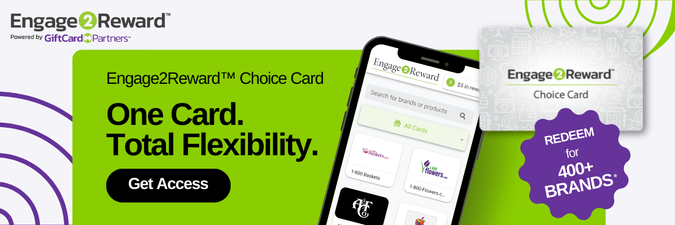
The Engage2Reward™ Choice Card supports this approach by allowing recipients to select from hundreds of brands, giving organizations the flexibility of one reward program without forcing every recipient into the same experience.
For enterprise programs, choice is not just a recipient benefit. It is a scalability strategy. The Incentive Research Foundation reported that gift cards continue to be the most widely used reward across North America and Europe, accounting for 30% and 34% of program allocations, respectively (3). For additional category planning, see Top Gift Card Brands for Corporate Gifting in 2026.
Mistake #7: Running Holiday Incentive Programs Without Reporting
Once rewards have been distributed, many organizations move on without evaluating what worked and what didn't. That makes it difficult to improve future programs or demonstrate the value of year-end recognition investments.
Large organizations benefit from tracking metrics such as budget utilization, reward delivery, participation, and redemption. These insights help HR, finance, and operations identify trends, refine future holiday programs, and provide leadership with greater confidence in incentive spending.
The most successful organizations treat holiday incentives as an annual program that becomes more efficient and effective each year, not a project that starts over from scratch every December.
How Large Organizations Scale Successful Holiday Incentive Programs
The organizations that avoid these common mistakes typically have one thing in common: they treat holiday incentives as an operational program rather than a series of manual tasks.
Instead of managing recipient lists in spreadsheets, chasing approvals through email, coordinating multiple reward vendors, and manually distributing gift cards, they centralize the process through a single platform.
The Engage2Reward™ Gift Card Ordering Platform centralizes holiday reward management. Organizations can manage budgets across departments, personalize rewards and messaging for individual employees or teams, schedule physical or digital delivery, distribute rewards in bulk, and monitor program performance from one centralized platform.
For organizations with global workforces or partner networks, the Engage2Reward Platform catalog provides localized gift card rewards across more than 60 countries, helping organizations deliver rewards that are relevant where recipients live. And the Engage2Reward™ Gift Card API automates reward delivery inside existing business systems, reducing manual administration while improving consistency and reporting.
Whether programs involve hundreds or thousands of recipients, centralized reward infrastructure helps organizations reduce administrative effort while improving visibility, consistency, and the overall recipient experience.
Conclusion
Holiday incentive success depends on more than choosing the right reward. Rewards must arrive on time, stay within budget, reach the right recipients, and deliver a consistent experience across departments and regions.
The strongest year-end programs rely on thoughtful planning, clear governance, scalable fulfillment, and consistent execution year after year. With the right infrastructure, organizations can create reward and incentive programs that are easier to manage, measure, and scale while delivering better recipient experiences.
Whether you're recognizing employees or channel partners for a year of hard work, the Engage2Reward Platform helps you personalize rewards, manage budgets, automate delivery, and distribute digital or physical gift cards across hundreds—or thousands—of recipients.
Ready to simplify your year-end incentive program? Contact our team to see how the Engage2Reward Platform makes reward management fast, flexible, and easy.




.png?width=600&height=600&name=3D8DC522-2245-490E-AA26-63567A199A4C%20.png)