



For years, people have predicted the end of physical payment cards.
Every time a new payment technology emerges, someone declares that debit cards are on their way out. First it was online banking. Then mobile payments. Then digital wallets. More recently, fintech apps and real-time payment rails have fueled another round of predictions.
Yet debit cards haven't disappeared. They are simply becoming less visible. According to PaymentsJournal, as consumers increasingly interact through mobile wallets and embedded payment experiences, debit cards often remain part of the underlying payment infrastructure. Federal Reserve research has also found that cards continue to play a major role as funding methods for digital wallet transactions, even when the consumer experience happens through a phone rather than a physical card.
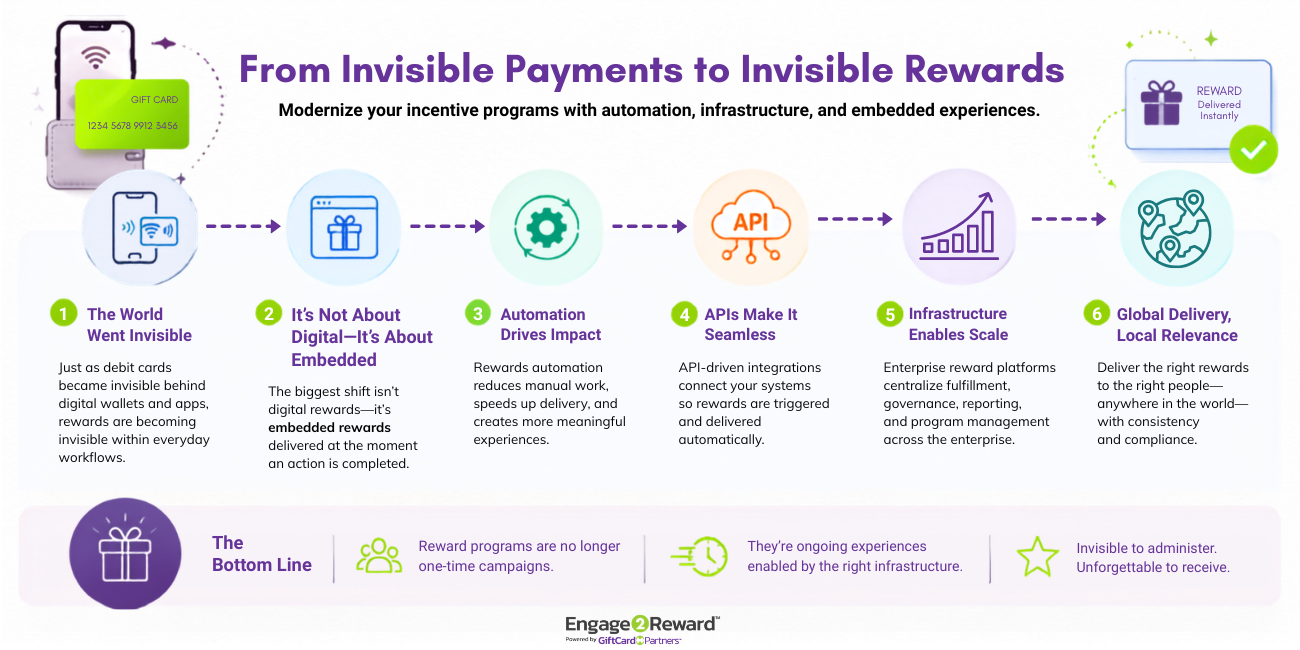
While examining how payment experiences have evolved, we noticed a striking parallel in the incentives industry. The same shift is happening with rewards.
Organizations have historically focused on the reward itself:
- What gift card should we offer?
- How much should the incentive be?
- Which brands do recipients prefer?
Those questions still matter, but they're no longer the whole story. Increasingly, the experience surrounding the reward is becoming just as important as the reward itself. Recipients expect rewards to arrive quickly, work seamlessly, and fit naturally into the digital experiences they already use every day.
In other words, people are beginning to think about rewards the same way they think about payments: They expect them to simply work.
Key Takeaway: The future of enterprise rewards programs will not be defined only by larger reward catalogs. It will be defined by rewards infrastructure: the systems, integrations, automation, controls, and fulfillment capabilities that help organizations deliver the right reward to the right person at the right moment, without adding manual administrative work.
What Is an Enterprise Incentive Platform?
An enterprise incentive platform, like the Engage2Reward™ Gift Card Ordering Platform, is a centralized system that helps organizations automate reward distribution, manage incentive programs, track budgets, enforce governance policies, and deliver rewards across employees, customers, channel partners, sales teams, health plan members, and research participants.
Rather than treating rewards as isolated campaigns, enterprise incentive platforms allow organizations to manage rewards as an operational capability.
Core capabilities typically include:
- Reward fulfillment and distribution
- Incentive program management
- Rewards automation
- API integrations
- Global rewards management
- Reporting and analytics
- Compliance and governance controls
As incentive programs expand across departments and regions, these capabilities become increasingly important.
Most Reward Programs Still Operate Like Payments Did a Decade Ago
Many organizations still manage rewards through manual processes:
Someone exports a report → Someone verifies eligibility → A spreadsheet gets updated → An approval email gets sent → A reward order gets placed → Eventually, the reward arrives.
The process works, but it often introduces delays at the exact moment organizations are trying to reinforce behavior:
A salesperson earns an incentive today but receives it next week; or a wellness participant completes a qualifying activity but waits days for a reward that could have reinforced engagement immediately.
None of these delays are catastrophic, but they create friction that reduces the impact of the reward itself.
Modern consumers have become accustomed to real-time experiences. Federal Reserve research shows growing adoption of digital wallets, instant payment capabilities, and embedded payment experiences designed to reduce delays and increase convenience.
Those expectations don't disappear when people enter the workplace.
The Real Trend Isn't Digital Rewards. It's Embedded Rewards.
When organizations discuss the future of incentives, the conversation often centers on digital gift cards. Digital delivery is faster, more scalable, and often more convenient than physical fulfillment.
But focusing solely on digital rewards misses the larger transformation. The real shift is toward embedded rewards.
What Are Embedded Rewards?
Embedded rewards are incentives delivered directly within existing workflows, applications, and business processes rather than through separate manual administrative processes.
Examples include:
- An employee receives recognition immediately after completing training.
- A sales representative earns a reward automatically after closing a qualified opportunity.
- A wellness participant receives an incentive after a verified preventive care activity.
- A survey participant is compensated immediately after completion.
The reward becomes part of the experience itself, such that recipients don't need to think about the infrastructure behind it. They simply receive recognition when they earn it.
That's the same transformation payments experienced as cards became embedded inside digital wallets and payment applications.
Why Rewards Infrastructure Is Becoming the Competitive Advantage
Historically, organizations differentiated reward programs through reward selection. While that remains important, many organizations now have access to similar reward catalogs.
The competitive advantage is increasingly shifting toward infrastructure.
What Is Rewards Infrastructure?
Rewards infrastructure refers to the systems, APIs, workflows, fulfillment capabilities, governance controls, and reporting frameworks that enable rewards to be delivered automatically and managed at scale.
As programs expand, complexity grows quickly.
Organizations often find themselves managing:
- Employee recognition programs
- Sales incentive programs
- Customer loyalty initiatives
- Wellness rewards
- Channel incentives
- Research participation incentives
- Survey rewards
Each program may have:
- Different stakeholders
- Different budgets
- Different approval requirements
- Different reporting needs
- Different compliance obligations
Without centralized reward operations, complexity compounds rapidly. The organizations that scale successfully are often those that stop treating rewards as campaigns and start treating rewards as infrastructure.
Why Rewards Automation Matters
The most effective reward programs don't necessarily offer the largest incentives; they remove the most friction.
What Is Rewards Automation?
Rewards automation uses workflows, integrations, APIs, and business rules to automatically issue rewards after predefined actions or milestones occur.
Examples include:
- Service anniversaries
- Training completions
- Sales achievements
- Customer referrals
- Wellness activities
- Survey participation
In practice, the operational value of automation is usually felt in small but important moments: fewer spreadsheet handoffs, fewer missed approvals, faster reward delivery, clearer budget tracking, and less time spent reconciling orders across departments. These improvements matter because incentive programs often lose impact when the reward arrives long after the qualifying action.
The value of automation extends beyond rewards. McKinsey research has consistently found that automation technologies contribute to productivity improvements by reducing manual work and streamlining business processes.
The same principle applies to incentive programs: when administrative tasks are automated, teams can spend less time processing rewards and more time improving engagement outcomes.
The Hidden Cost of Manual Reward Operations
Many organizations underestimate how much effort is required to manage rewards manually.
Common challenges include:
- Tracking eligibility
- Managing approvals
- Reconciling budgets
- Ordering rewards
- Monitoring delivery status
- Consolidating reporting across departments
As programs grow, these operational burdens scale alongside them. This is why many organizations are investing in incentive automation and centralized reward fulfillment platforms to eliminate unnecessary administrative effort.
What Organizations Should Look for in a Reward Fulfillment Platform
As rewards become more embedded within business processes, reward fulfillment capabilities become increasingly important.
When evaluating a reward fulfillment platform, organizations should look beyond the reward catalog and assess whether the platform can support the operational realities of running programs across teams, regions, and systems. Important capabilities include:
Automated Reward Distribution: Rewards should be triggered automatically based on verified actions and predefined rules.
Global Rewards Management: Organizations need the ability to deliver locally relevant rewards across multiple countries while maintaining centralized visibility and governance.
Flexible Reward Options: Programs should support digital rewards, physical rewards, prepaid solutions, charitable options, and other incentive formats.
Centralized Reporting: Administrators need visibility into spending, engagement, fulfillment status, and program performance.
Governance and Compliance Controls: Organizations require approval workflows, budget controls, and auditability.
API-Driven Integrations: Rewards should integrate with HR, CRM, wellness, survey, learning, and sales performance systems.
The most important test is whether the platform reduces administrative friction without reducing control. A strong platform should make rewards easier for recipients to receive, easier for administrators to manage, and easier for finance, compliance, and program owners to monitor.
Global Rewards Programs Make Infrastructure Even More Important
As organizations become more distributed, reward management becomes more complex.
Different countries may require different reward options, fulfillment methods, and compliance considerations. This is where global rewards management becomes essential.
Organizations need the ability to maintain centralized governance while supporting locally relevant experiences.
The larger the audience becomes, the more important infrastructure becomes.
How API-Driven Rewards Work
Perhaps the clearest example of invisible rewards is the growing use of APIs like the Engage2Reward™ Gift Card API.
What Are API-Driven Rewards?
API-driven rewards connect business systems directly to reward infrastructure so incentives can be triggered automatically when qualifying actions occur.
A typical workflow looks like this:
A user completes a qualifying activity → The source system verifies eligibility → An API sends a reward trigger → The reward platform fulfills the incentive → Reporting updates automatically.
Examples include:
- HR systems issuing work anniversary rewards
- Learning platforms triggering training incentives
- Wellness platforms delivering health rewards
- CRM systems rewarding sales achievements
- Survey platforms compensating participants
To recipients, the experience feels immediate. To administrators, it eliminates manual work.
The reward becomes part of the workflow itself.
The Rise of Invisible Rewards
The most successful payment experiences today are often the ones consumers barely notice. They happen instantly, seamlessly, and exactly when they're needed.
Rewards are moving in the same direction. The future of enterprise reward automation isn't simply digital gift cards. It's the convergence of:
- Rewards infrastructure
- Automated fulfillment
- API-driven integrations
- Global distribution capabilities
- Centralized governance
Together, these capabilities create an experience where rewards become nearly invisible so well that recipients no longer have to think about the process. That may be the clearest sign that a rewards program is doing exactly what it was designed to do.



.png?width=600&height=600&name=3D8DC522-2245-490E-AA26-63567A199A4C%20.png)