



Healthcare costs continue to be one of the largest and least predictable expenses facing self-insured employers. While organizations often focus on managing pharmacy spend, negotiating provider contracts, or analyzing high-cost claims, many overlook a much simpler problem hiding in plain sight: employees are not completing preventive care.
Annual physicals are skipped, cancer screenings are delayed, and vaccinations are postponed. Chronic conditions go unmanaged until symptoms become severe enough to require intervention. In fact, a recent Aflac survey found nearly 90% of employed adults have delayed getting a checkup or routine preventive screening.
The result is a pattern that plays out repeatedly across employer-sponsored health plans. A relatively inexpensive preventive service is missed, a condition progresses unnoticed, and the eventual treatment becomes significantly more costly than early detection or intervention would have been.
For self-insured employers, those costs don't disappear into an insurance carrier's balance sheet. They often show up directly in the organization's healthcare spend.
The Most Expensive Claims Often Start as Preventable Problems
When employers review healthcare claims data, high-cost events frequently receive the most attention. Hospital admissions, emergency room visits, surgeries, and specialty treatments can represent a disproportionate share of annual healthcare spending.
What is often harder to see is the chain of events that led there:
A missed colorectal cancer screening may delay diagnosis until treatment becomes more complex and expensive.
An employee who postpones a routine physical may not discover elevated blood pressure until a cardiovascular event occurs.
An unmanaged prediabetes diagnosis can eventually develop into Type 2 diabetes, bringing years of additional medical costs, medications, and potential complications.
The challenge is that preventive care savings rarely appear as a line item on a report. Organizations can easily see what they spent on a hospitalization. It is much harder to measure the hospitalization that never happened because a preventive screening identified a problem early.
That doesn't make the financial impact any less real.
Why Employees Skip Preventive Care
Most employers assume that if preventive services are covered by their health plan, employees will naturally take advantage of them.
Unfortunately, coverage alone rarely drives action. People are busy. Many individuals avoid healthcare visits unless they feel sick; others simply forget that screenings or annual wellness visits are due.
In some cases, employees understand the value of preventive care but never get around to scheduling appointments. In other cases, there may be concerns about time, inconvenience, transportation, or uncertainty about where to go.
The barriers are often surprisingly small, yet those small barriers can have significant financial consequences when multiplied across an entire workforce.
The Participation Problem
This is where many employer wellness initiatives struggle.
Organizations invest in communications campaigns, wellness portals, educational resources, and awareness programs. Employees may appreciate the information, but awareness does not always translate into action.
Participation remains one of the most persistent challenges in population health management. Employers know that preventive care completion rates matter. The question becomes how to encourage employees to take the final step and actually complete the desired action.
Behavioral science offers a useful clue: people tend to respond to immediate and tangible reinforcement. A future benefit, such as avoiding a health issue years from now, often feels abstract. A reward received shortly after completing a preventive health activity feels concrete and immediate.
Why Incentives Continue to Gain Attention
Incentives are not intended to replace intrinsic motivation or personal responsibility. Their role is much simpler: they create a reason to act now instead of later.
When employees receive a reward for completing a preventive health activity, the appointment moves from an item on a to-do list to a completed task with an immediate benefit.
Employers have been using incentives to encourage behaviors such as:
- Annual wellness visits
- Preventive screenings
- Vaccinations
- Health risk assessments
- Biometric screenings
- Chronic disease management activities
- Wellness coaching participation
Gift cards remain one of the most widely used and consistently preferred incentive options because they combine recipient choice, flexibility, and ease of distribution. Many organizations are also moving away from one-size-fits-all rewards and toward choice-based incentives that allow recipients to select rewards that are personally meaningful.
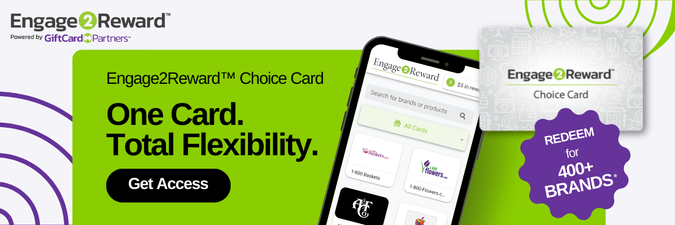
For example, the Engage2Reward™ Choice Card gives recipients access to hundreds of gift card options through a single reward experience, helping employers deliver incentives that appeal to diverse employee populations without increasing administrative complexity.
The reward itself does not need to be extravagant. In many cases, a modest incentive can provide enough motivation to increase participation among employees who were already considering taking action.
Connecting Incentives to Verified Health Actions
One reason some wellness programs fail to deliver measurable results is that incentives are not directly connected to completed health activities. Successful programs focus on verified actions. Rather than rewarding intention, they reward completion.
For example, an employee completes an annual physical. The completion is verified through a healthcare partner, benefits administrator, claims process, or approved workflow. Once verified, a reward is delivered.
This approach creates accountability while helping employers understand which activities are driving participation. It also enables organizations to measure program performance more effectively over time.
For organizations managing large-scale wellness initiatives, automation becomes increasingly important. Through the Engage2Reward™ Gift Card API, rewards can be automatically triggered and delivered when a qualifying health action is verified, reducing manual administration while creating a faster and more seamless experience for participants.
The Operational Challenge Most Employers Underestimate
Encouraging preventive care is only part of the equation. The administrative burden behind incentive programs often becomes the larger obstacle.
Many organizations begin with good intentions but quickly encounter practical questions:
How are completions verified?
Who approves rewards?
How are budgets managed?
How are rewards distributed?
How can participation be tracked across multiple programs?
How does the organization ensure a consistent employee experience?
Manual processes can quickly become difficult to manage, especially for larger employers or organizations running multiple health initiatives simultaneously.
As preventive care incentive programs mature, many employers begin looking for ways to automate reward fulfillment, improve reporting visibility, and reduce administrative effort.
This is where incentive infrastructure becomes increasingly important. Solutions such as the Engage2Reward Platform provide centralized budget controls, approval workflows, reporting tools, and reward fulfillment capabilities that help organizations manage preventive care incentive programs at scale.
The goal is to build a program that is sustainable, scalable, and easy to manage.
Why Reward Timing Matters
One of the most overlooked factors in preventive care incentive design is timing.
An employee who receives a reward weeks or months after completing a health activity may no longer associate the reward with the behavior being encouraged. Immediate reinforcement tends to be more effective.
Digital gift card incentives delivered shortly after verification help strengthen the connection between action and reward. Instant digital delivery through email or SMS can improve the participant experience while reducing fulfillment delays and administrative effort.
For employers, this creates a more responsive and engaging incentive program without introducing additional operational complexity.
Looking Beyond Wellness Program Participation
The conversation around wellness programs often centers on engagement metrics:
How many employees participated?
How many completed a screening?
How many redeemed a reward?
Those metrics are useful, but they are only part of the story.
The broader objective is reducing preventable healthcare costs by encouraging employees to take actions that support earlier intervention, better health management, and improved long-term outcomes.
For self-insured employers, preventive care is not simply a wellness initiative; it is a cost-management strategy. Every completed screening, wellness visit, vaccination, or chronic disease management activity represents an opportunity to address health risks earlier, when interventions are typically less complex and less expensive.
The most successful programs increasingly combine behavioral incentives with scalable, compliance-ready reward infrastructure that enables organizations to deliver rewards consistently, track outcomes, maintain program governance, and automate fulfillment processes.
While no incentive program can eliminate healthcare costs, encouraging greater participation in preventive care may help organizations address one of the most avoidable drivers of long-term healthcare spending: delayed action.
Final Thoughts
For self-insured employers, missed preventive care is a cost-containment challenge.
Many of the most expensive healthcare claims begin long before an employee enters a hospital or specialist's office. They often start with a missed screening, a delayed annual physical, an overlooked vaccination, or an unmanaged chronic condition.
Preventive care incentive programs can help close that gap by encouraging employees to complete important health actions before small issues become costly medical events.
The organizations seeing the strongest results are not simply offering rewards. They are building scalable programs that combine verified health actions, immediate incentives, automated fulfillment, reporting visibility, and compliance-ready administration.
Platforms like Engage2Reward help make that possible through instant digital reward delivery, choice-based incentives, API-driven automation, centralized controls, and reporting tools that support preventive care engagement at scale.
Ultimately, the goal is simple: increase participation in preventive care today to help reduce preventable healthcare costs tomorrow. For self-insured employers, that may be one of the most practical opportunities available to improve both employee health outcomes and long-term healthcare spending.
Ready to increase preventive care participation? Schedule a consultation to see how the Engage2Reward Platform can help you turn health program participation into measurable results.




.png?width=600&height=600&name=3D8DC522-2245-490E-AA26-63567A199A4C%20.png)